



Reader Read-In Note: In all that “spare time I have” I began a website earlier this year based on Hour-A-Day-Gardening.” That site got a warm reception, but as always, time for that project became limited, though it served a critical purpose in my life. See, most gardens fail because people don’t begin by making a “routine first” and then filling in specific tasks later.
In the case of HAG, I did things the other way around. Not only have we enjoyed some very good hydroponics as a result, but we’re also learning tons, oodles, and gobs about electroculture. Which we will cover in a subsequent report. But the key thing about our operation here? It’s being done in our “music studio” (air conditioned space with an average summer temp of 76F. While the greenhouse is of the knocked-togther “lean-to” sort cobbled up two or three years back when son George2 was down here for a while.
It has been a great greenhouse. We have gotten lots of edibles out of it including good winter production thanks to a “Chineseum” diesel heater which kept the indoor temps around 55F minimum even when temps outside were dropping into the twenties. That adventure was a ShopTalk column called the Greenhouse Chinese Diesel Heater Install.
That gives you enough of the backstory that moving this morning will make sense – sort of.
Foodening ? Gardening or Prepping
Before getting into greenhouse thermal control engineering (we’ll get there, keep Ure shirt on!) I should explain that a lot of “domain-thinking” around here has been focused on getting out of old-style silo thinking and more into domain-agile worlds.
The term “vertical market” in advertising sums up how “silo thinking” works. You take a topic – gardening say – and then you focus solely and diligently on that one activity. To the exclusion of all (ezxcept the most unavoidable, in Ure face) related topics.
Domain-thinking is learning to think in logical linkage land.
Wjhat you come to is that Foodening.com is not only a “web domain” but it’s also a great description of a humongous realm of human endeavor. Weather forecasting, energy shipping and fertilizer production, science in labs for GM seeds, marketing, food storage, warehousing,a preservation, home housing for food (in the fridge), and even the cooking appliances. In the end, one of the last Foodening processes ends with Charmin and a slightly “flushed” feeling.
Point is? Foodening is the processing of food. Gardening doesn’t process “gards.” Nor would be call it a purely “vegetative state.” However, it’s not a crispy Daguet hot out of the oven. We quickly see how supply chains, home gardens, and the grocery store are all subsets of food processing that involves a few healthy fats, proteins, and carbs, “sticking to the ribs” on the way by us. Foodeners.
Eventually, I’d “write backwards” and offer a ShopTalk/Foodening/HourADay on greenhouses. I like ’em, they do good work, and they take a lot of old-school, time-intensive bullshit labor out of the personal foodening process. All green stars there. Some pictures of year one can be found in ShopTalk Sunday: Garden Prepping, Eats & Treats.
Thermal Issues of Greenhouses
Recent talk about fertilizer shortages, hantavirus run potential, and the screaming increases in food prices hinted at in Producer Prices this week, sharpened out focus into looking at what would need to be done to:
- Increase summer yield.
- Increase the fall garden yield.
- Give more tomatoes around Christmas,
- And be fruiting heavily by late winter into early spring.
Our greenhouse (version 1) was really good. But, it fell a few notches shy of (cue Tony the Tiger here…) “Gurrreat!”
Too Much Heat, and Too Much Cold? Same Problem
That’s what the first pass at cooling down the summer heat here revealed.
Our greenhouse was getting up to 103F on hoet days and that was after putting in a new swamp cooler and a new 3,100 cfm exhaust fan.
When I laid out the initial build, the air intake was in the shade (north side of the house) and the exhaust was up high on the north end with a foot of elevation gain. So we were working with – not against – solar temperature gradient flows.
But the more I got into it – and AI’s really useful for this kind of engineering work – the more it became clear that I had several problems that were stacking.
Old Paint Story
Long-time readers may remember the the first framing of the greenhouse was done with Penofin rose wood oil stain. Elaine – artiste in residence fors 26 years of marriage so far – call out and shrieked. “Orange??? It has to go!!”
My second pass was flat black. Had that nice PNW architectural vibe to it and in the winter we notice ed good heat gain from it.
But with AI’s help, we narrowed that down to one of the main summer problems. Againb, more research and a gallon of primer and exterior all-in-one paint and some toss-out brushes, and I was drinking around fro an hour before the heat came up to slap white semi-gloss on all sun-facing surfaces.
Even with just half the sun-facing flat black painted on Tuesday, it took the top 5-degrees off the afternoon broiler. More as the week moved on and my “paint among the ‘maters” continued.
The next thing I found was that putting an assortment of “space blankets” (mylar prepper crap we may never live long enough to use) really started to strut its reflectivity as the semi-gloss sent photons instead of flipping them into a cooling problem.
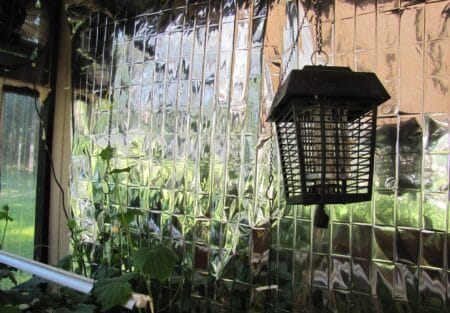
And the research continued.
For example, as part of the electroculture research project, we identified that the grow lights – which have been rocking-out the green leaf growth – were also tossing back 250-watts of heat 16-hours a day. Opps!
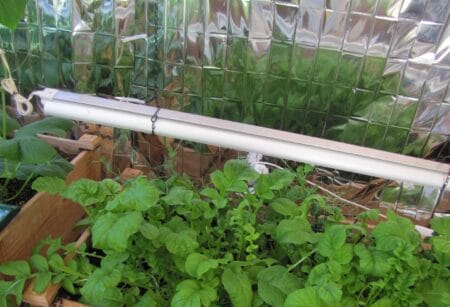
Which gives you gigantic radish greens, but as long as plants are in the “vegetative growth Nirvana state” they aren’t going to flower OR bulb.
With the additional white vertical structural members, the light is still very good – even with a 40 percent shade cover directly overhead because I can’t be applying BBQ sauce all day on the plants. But it has knocked off 10-degrees. And if you ever get into a position where foodening becomes part of surviving? That’s valuable knowledge to be accumulated now while Amazon is still delivering every day.
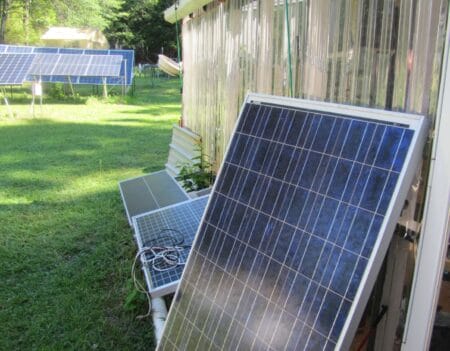
A couple of other ways to knock-down heat. We have some 20-year old solar panels laying around, so I leaded two of those up against the sidewall (west) where afternoon sun was bcrutal and no plants were in play.
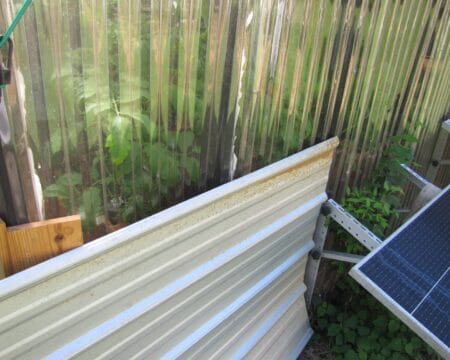
At the north end of the room, a leftover hunk of roofing tin got the sun off the tomato planters on the inside. AI tells me as the root temps come down, the urge to set fruit will likely reignite.
This doesn’t mean we are done engineering. I still have a FLIR-type heat camera (home surveillance toolkit, right?). But, I wanted to do this part of learning as a hands-on, ground-up in order not to rely on tech which may not be around.
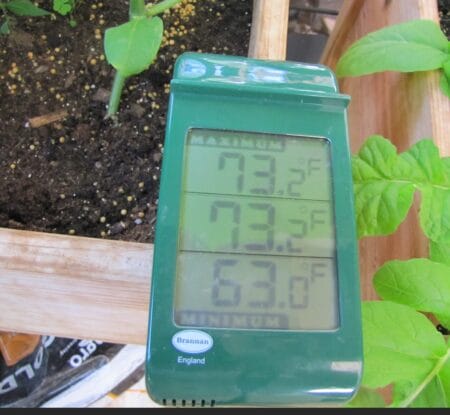 Still, we huge fans of real greenhouse type high-low digital thermometers.
In addition to using a couple (one at canopy height and one at root level) we can see what is going on very nicely with plant comfort.
By the way, if you have a solar-power pantry building for food storage (You don’t???) keeping one in that space will give you daily assurance that you have cooling for food storage under control. Canned goods tend to fall apart stored over 90F or under 30F for extended periods.
And excuse the appliance salesman pitch where I remind you that the cheap air conditioners which have mechanical switches (they come on automatically after power bumps) are only way to fly in that kind of space.
One other “sneaky Pete”? (A reference to the TV show, not the SecDef.) An on sale candy thermometer from Amazon is an easy way to check root ball temps.
Stage 2 Cooling Plans
Any ShopTalk project worth doing is worth over-doing. We will be doing Stage 2 Cooling.
This will consist of a seal airbox from outside into the swamp cooler. A bit of 1/4″ plywood and clever j0ointery ought to do it.
On the outside west and north walls? Planter height closed cell foam withy ply-over will add serious heat barrier (OK, 2 is still better than zero) and going with 5-foot high twinwall instead of single layer corrugated Lexan will also improve the heat transfer picture.
Less hurry with those aspects for now. The heat’s already on, though the airbox may come this week.
A?fter that? My biggest realization about my own Foodening mindset was I tend to plant too early in the fall. I aimed for late August – which is 2-3 weeks too early. And I have not been on top of the winter-over garden. In fact didn’t even run the diesel heating this winter. Sometime, when you’re on a diet, having food delivered work and is a real joy.
But if good times don’t last forever, that’s why the hands-on skills matter now and will be something to pass on in the future.
Write when its ripe,
Read the full article here