



In the first mowing tale – and I have seen this first-hand – the workman comes out, starts the lawnmower and then carefully mows the yard. Forth and back, but stopping and reversing course frequently in order to ensure he hasn’t missed a spot. The basic mowing takes him two hours.
As the tale unfolds, the scene looks eerily familiar. He goes around the yard edges with a weed whacker. A few places were a bit tall, the grass thick. So he follows up with a raking to make sure the yard is STRAC and could pass inspection. 25 minutes, but the yard looks good. Well, except for…
He moves on to the eyesore. Tackling the small patches of hedge, he does it as he learned. A short two-step ladder is all he needs. Or is it? Then he unwinds a 100-foot extension cord and begins his plant-barbering task.
When complete, the rake is out, once again. Neat piles are collected and lifted into lawn and yard sacks. Aha, but there’s the 100-foot extension, which must first be dried off with a rag before being more properly coiled. All-in, it’s a 40-minute task. His wife had moved the two-step ladder.
Then he sees a few weeds are peeking out from the beauty bark. So the next 15 minutes goes to the weeds.
The Management Consultant shows up to review his work. “Yes, yes, looks good. But, let’s add up your time. Two hours mowing, 25 minutes weed whacking and raking. Forty minutes on the hedge work. And fifteen on the beauty bark.”
Our workman nods – knowing it was hot and he’d given it his all.
“We will call it three hours and twenty minutes,” the consultant finally announced.
“A terrible performance. You need to read this.”
At that, the consultant handed him a simple pamphlet. He read its cover:
“Ure’s Yard Cuts”
Chapter One: The ORDER OF WORK Matters
Always trim and edge before mowing.
The reason for this rule is simple: A high-powered rotary lawnmower is – at its heart – a mulching machine.
A savvy tree farmer doesn’t waste effort. He performs work in an order that eliminates work when possible.
If you trim and edge first? The lawnmower mulches and disposes, saving money on plastic bags.
In our example task list, the work order for top efficiency becomes:
- Run a brush hog around trees and beds that are big enough.
- Trim hedges with proper tools.
- Edge before mowing.
- Mow using “Special Tricks”.
- (If guests are expected) Blow off the walkways and patios.
Chapter Two: Big Tools Save Big Time
Time to brush hog around trees (our “beds”). Seven minutes.
(I know “Not fair! You have a diesel tractor!” Yeah, your point? I have the cute blonde and outlandish shop, too. Choices bring consequences, Sport. Ever read “I bargained with Life for a Penny?” Go read it.)
Hedges are Fast Too!
From this:
To this:
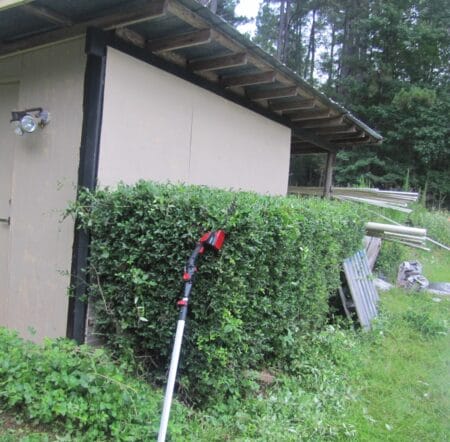
Buy the Right Tools
Look at your yard honestly. What would the perfect tool be?
- Hedge trimmer must be battery powered. I hate cord-cleaning.
- Must have a flex head on it – I can top a 12-foot-high ficus without a ladder or overextending.
- Use the tip of the hedge trimmer as a hook to pull your trimmings out to where your mower pass will chew up the cuttings into mulch. Like so:
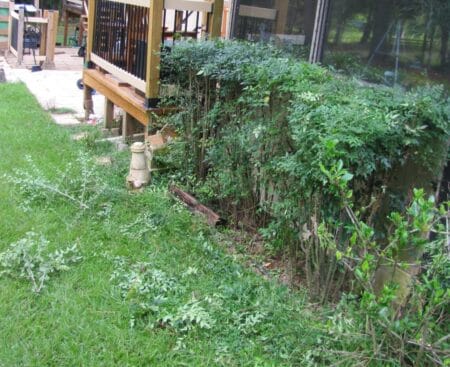
Chapter Three: Start Times Govern
Let’s apply some science to the Yard tasks.
The overwhelming governor is lawn moisture. You want to cut grass when most of the dew has burned off. If you mow too early, especially if grass is long, it will “clump up” leaving an unprofessional looking result.
On the other hand, if you wait too long, all the moisture will be gone. In which case, because you run the mower at high speed (faster blades=more lift and longer discharge field) dry ground will kick up more dust. That can get cars dirty and you will get more dust onto the patios and decks.
Think of it this way: You know how LOOB talks about pasta having a perfect al dente state? Well, your lawn – when mowing – has the same thing. Almost dried of dew but not so dry that it cracks or throws dust. Your mower is a scaled-up Norelco triple-header, right?
Mower Start-Time Calculations Table
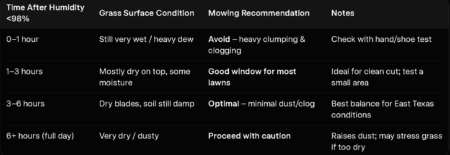
For a yard our size, starting to mow at the 90% RH level works about perfect. Low dust, good discharge throw, minimal clumping. Your yard will vary.
Advanced students can sign up for the optional high-lift versus medium-lift blade correction symposium.
Chapter Four: Three for the “Mowed”
First point: Use “discharge awareness”. Decide in advance:
- Do you want to blow clippings toward or away from your neighbor’s yard when you share a property line? Are they dicks, and do they blow theirs your way? If so, learn their schedule and mow right afterward to send it back. (MJR = Mower Justice Riders!)
- Do you want to blow into or away from a fence line? The into fence line works here – when burning fence lines it gives more even fire. And slower weed growth from the power mulching. Do you mow toward or away from your home? I do two passes discharging away from the house and by then, the discharge cone is low enough not to break things. (Recent glass storm door breakage was a fluke.)
- And what is your “trim plan?” I like to make all my “cut-ins” so that I can mow 95 percent of the yard without going into reverse. Sure, you can stop, reverse, and so forth. But that takes time and if you preplan your route 90 percent of your mowing time can be full tilt forward and get ‘er done.
Finally, use the under-deck washer attachment if your mower has one. When using it, position the mower over a big concrete block or you will blast a deep hole into the earth and make a muddy mess rather than a well-executed finish to the job.
Final Chapter: Time is Beer
Total Ure sequence: perhaps 95-112 minutes, with no bagging, no cord drying, and no second cleanup pass. In year 78 on the rock-ride, make every minute count twice.
On that? I have “mow to do” so that maybe the ham radio Hermes Lite 2.0 build will make it onto the schedule next week.
Working on the Future?
Yeah – us, too. See the latest on my AI dev site: Meet the Grim Reaper — and His Brother – Hidden Guild.dev. More bubbles than a bath tub.
Write when the beer’s cold (but only if there’s some left)
Consider subscribing to our deeper work.
Read the full article here