

11

Potassium iodide is discussed in prepper circles like it’s some kind of all-purpose anti-radiation pill. It isn’t.
But that doesn’t mean it’s useless! There is a reason it’s distributed to people living around nuclear reactors. There is a reason why it was distributed to civilians living around Chernobyl at the time of the reactor meltdown.
Potassium iodide, also known as KI, does offer some protection, but make sure to understand what it actually does and when to take it. If you stock potassium iodide, thinking it will broadly protect you from nuclear fallout, you are misunderstanding its use.
KI only helps protect the thyroid from radioactive iodine. It does not protect your entire body, and it does not protect you from most other radiation hazards. [1]
What potassium iodide actually does.
Potassium iodide is a stable, non-radioactive form of iodine. If radioactive iodine is released into the environment, your thyroid can absorb it. KI works by flooding the thyroid with non-radioactive iodine first, which helps block uptake of the radioactive form. That can reduce the long-term risk of thyroid cancer, especially in younger people. [1]
What potassium iodide does not do.
KI does not protect your entire body from radiation nor does it protect against all radioactive materials. It does not make fallout safe, and it certainly doesn’t replace sheltering, evacuation, and avoiding contaminated food and water. Those offer much better, full-body protection. [1] [3]
What to build a fallout shelter yourself? See my Free Fallout Shelter Plans article.
Timing matters.
KI works best when taken within 24 hours before exposure or within 4 hours after exposure. The World Health Organization says the best timing is ideally less than 24 hours before exposure and up to 2 hours after, though taking it up to 8 hours after may still offer some benefit. After 24 hours, it no longer provides protection. [1] [3]
Who benefits the most from KI.
Not everyone benefits equally from potassium iodide. KI is primarily for people under 40 and for women who are pregnant or breastfeeding. Infants, children, teens, and younger adults face a higher long-term risk of thyroid cancer from radioactive iodine exposure. Adults over 40 generally don’t benefit from it unless the predicted thyroid exposure is unusually high. [1] [2]
I would recommend stocking KI if your household has the potential to be harmed by radiation resulting from some nuclear catastrophe, but there are also other items to stock for nuclear war.
Who should be cautious.
People with known iodine sensitivity should avoid it. People with thyroid conditions and heart disease may also need to avoid it. [1] [2]
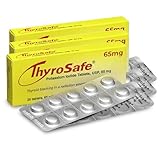
ThyroSafe 65mg Potassium Iodide Tablets (60 Pack) – Protects Your Thyroid from Nuclear Radiation Exposure
- Thyrosafe is a protection tablet, meaning it is approved for use by you and your family in the event of radiation exposure.
- Long Shelf Life — Add ThyroSafe to your survival supplies as your chosen potassium iodide radiation tablets. These tablets last for years, making them a great addition to your prepper gear and…
- Suitable for All Ages — Potassium iodide can be taken by family members of any age, and ThyroSafe tablets are scored for easy splitting. Dosing instructions are listed clearly on the packaging.
- When to Take – Potassium iodide tablets should only be taken when directed by a public official in the event of an emergency.
Potassium iodide dosage by age.
The CDC’s recommended single-dose guidance is as follows: [1]
- Infants birth through 1 month: 16 mg
- Children 1 month through 3 years: 32 mg
- Children over 3 years through 12 years: 65 mg
- Adolescents 12 through 18 years: 65 mg
- Adults over 18 through 40 years: 130 mg
- Pregnant or lactating women: 130 mg
- Adults over 40 years: 130 mg, but generally only when officials recommend it at high predicted exposure levels
Teens over 150 pounds should take the adult dose. One dose protects for about 24 hours. For infants and small children, liquid KI may be the most practical form if it’s available.
Repeated dosing risks.
One dose protects for 24 hours, but repeated dosing comes with risks. The CDC warns that infants younger than 1 month are at especially high risk from radioactive iodine, but repeated doses may also lead to later problems with normal development. [1]
The WHO adds that in prolonged exposure situations, repeated doses are not appropriate for everyone. Neonates, pregnant women, breastfeeding women, and some older adults may require different consideration and medical guidance. [3]
The practical takeaway
First, see KI as one piece of a larger radiation preparedness plan. Sheltering, evacuation, and avoiding contaminated food and water are the top priorities.
Second, if you live near a nuclear power plant or a likely target in a nuclear war, keeping KI on hand is a reasonable preparedness move. I would stock it. I stock it now.
Third, plan ahead. Who would actually be the priority for KI in your family? In most cases, kids will comes first.
But what do you think? Is potassium iodide worth stocking?
Sources
[1] Centers for Disease Control and Prevention. “Potassium Iodide (KI).”
https://www.cdc.gov/radiation-emergencies/treatment/potassium-iodide.html
[2] U.S. Food and Drug Administration. “Frequently Asked Questions on Potassium Iodide (KI).”
https://www.fda.gov/drugs/bioterrorism-and-drug-preparedness/frequently-asked-questions-potassium-iodide-ki
[3] World Health Organization. “Use of potassium iodide for thyroid protection during nuclear or radiological emergencies.”
https://www.who.int/news-room/questions-and-answers/item/use-of-potassium-iodine-for-thyroid-protection-during-nuclear-or-radiological-emergencies
Read the full article here