


Key Takeaways
- The Massachusetts Supreme Judicial Court will hear Pratt v. Westbrook on October 7, addressing the suitability standard for issuing carry licenses.
- Holyoke Police Chief David Pratt denied Randy Westbrook’s application based on past, unconvicted charges, raising questions about subjective judgment.
- Westbrook’s legal team argues this standard violates due process and lacks clear definitions for ‘suitability.’
- The case’s outcome could impact current Massachusetts gun laws, which have similar suitability language.
- The Second Amendment Foundation claims the suitability standard allows for improper discretion and requires objective criteria for licensing.
Estimated reading time: 5 minutes
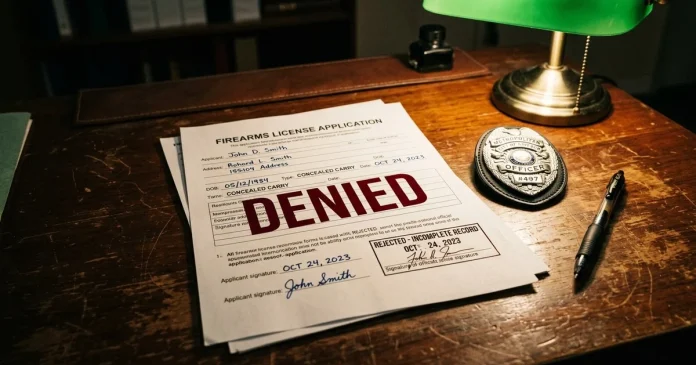
HOLYOKE, MA — The Massachusetts Supreme Judicial Court will hear oral arguments on October 7 in Pratt v. Westbrook, the case asking whether the “suitability” standard that lets a Massachusetts police chief deny a license to carry can survive the Second Amendment. Randy Westbrook applied for a license to carry in 2023. Holyoke Police Chief David Pratt turned him down as “unsuitable” over two sets of criminal charges from more than a decade earlier.
When the Second Amendment Foundation filed its amicus brief in this case, a friend-of-the-court filing from a group that is not a party but wants the judges to hear its argument, I covered it in Charges From Over a Decade Ago, Never Convicted, Still Denied: SAF Takes a Police Chief’s Carry Denial to Massachusetts’ Highest Court. What has changed is that the SJC has now put the case on its calendar, as reported by CommonWealth Beacon, whose account also lays out the path the case took to get there.
The charges Pratt relied on, per CommonWealth Beacon, were an assault and battery charge involving Westbrook’s pregnant girlfriend and charges tied to a vehicle stop that turned up 17 baggies of powder and crack cocaine. Neither set of charges ended in a conviction, according to SAF. Under the statute in force in 2023, a licensing authority could not issue a license to an applicant found unsuitable “based on reliable, articulable and credible information” that the person’s behavior indicates they “may create a risk to public safety or a risk of danger to self or others.” That is the language on trial. This is not a question of whether Westbrook is a prohibited person. It is a question of whether a chief can read a decade-old arrest record and decide, on his own judgment, that a man “may” be a risk.
Westbrook challenged the denial in a suit funded by the Gun Owners’ Action League. His lawyers argue the statute is “vague, overbroad” and violates due process because it never defines what makes a person unsuitable or how an applicant could fix it. A Holyoke District Court judge agreed, citing Bruen, the 2022 Supreme Court decision that struck down “good reason” carry licensing in states like New York and Massachusetts, and declared the suitability standard unconstitutional. The chief and the attorney general’s office appealed, and a Hampden County Superior Court judge reversed. Westbrook appealed again, and the SJC agreed to take the case. Neither lower court decision was available to me, so that sequence rests on CommonWealth Beacon’s reporting rather than the opinions themselves.
The stakes run past one applicant in Holyoke. CommonWealth Beacon notes that the sweeping 2024 Massachusetts gun law carries nearly identical suitability language, so a ruling against this level of discretion would reach the rules on the books today, not just the version Pratt applied in 2023. Anyone applying for a Massachusetts license to carry right now is applying under a suitability test the SJC is about to examine.
SAF’s brief, filed September 2 with the California Rifle & Pistol Association, the Second Amendment Law Center, the Minnesota Gun Owners Caucus, and the Citizens Committee for the Right to Keep and Bear Arms, argues that the suitability statutes hand licensing officials exactly the kind of discretionary “appraisal of facts, exercise of judgment, and formation of an opinion” that Bruen’s footnote 9 said has no place in a shall-issue system, meaning one where the official checks objective boxes and issues the license. Attorney Jason Guida served as local counsel pro bono. SAF also contends that the Supreme Court’s decisions in United States v. Rahimi and United States v. Hemani require that any disarmament of a person never convicted be temporary and tied to current dangerousness, two limits SAF says the Massachusetts statute lacks.
“Bruen already resolved this question,” said SAF Director of Legal Research and Education Kostas Moros. In his view, an official may verify objective criteria like prohibited-person status and completed training, but may not decide whether an applicant “may” pose a risk based on old, unproven allegations. “Massachusetts’ suitability standard is textbook subjective discretion, and it cannot stand.”
SAF founder Alan M. Gottlieb put it plainer: “Americans who have never been convicted of a crime should not have to live indefinitely under the threat of a subjective veto over a fundamental right.”
More from USA Carry:
Those are the arguments of an amicus, not the record, and the SJC has ruled on nothing yet. Pratt and the attorney general will make their case for the statute on October 7. But the question the court agreed to answer is the one that matters for every applicant in the state: whether “may create a risk” is an objective standard or a chief’s opinion given the force of law.
I will continue tracking Pratt v. Westbrook through the October 7 arguments and the SJC’s decision.
Read the full article here