


Key Takeaways
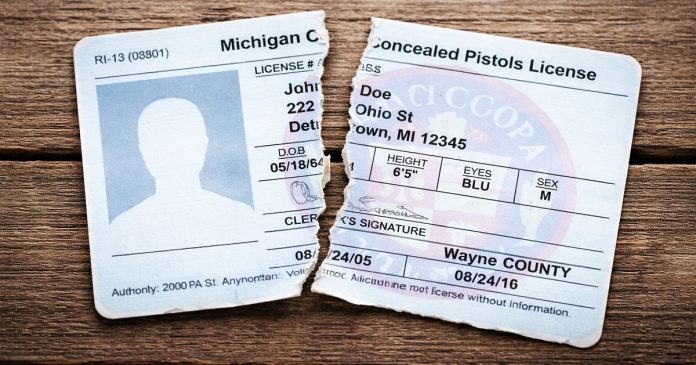
- Michigan House Republicans introduced a package to eliminate the Concealed Pistol License (CPL) requirement for concealed carry.
- Supporters argue the proposal aligns with Second Amendment rights and removes unnecessary government barriers.
- The legislation maintains the option to obtain a CPL for reciprocity but eliminates the permit requirement and safety course mandate.
- If passed, Michigan would become the 30th state to adopt constitutional carry, with proponents emphasizing the right to self-defense.
- The bills await further action in committee, with sponsors hopeful for support despite uncertainties.
Estimated reading time: 4 minutes
LANSING, MI – A group of Michigan House Republicans has introduced a legislative package that would eliminate the requirement to obtain a Concealed Pistol License for concealed carry in the state.
House Bills 5653 through 5657 were introduced today, March 3, and referred to the House Judiciary Committee. Lawmakers described the proposal as a constitutional carry package designed to remove what they call unnecessary government barriers to exercising Second Amendment rights.
Under current Michigan law, carrying a concealed pistol without a license is a five-year felony. Supporters of the legislation argue that this places otherwise law-abiding citizens at risk of serious criminal penalties over technical violations.
Rep. Joseph Fox, a sponsor of the bills, said the package would eliminate the requirement to obtain a CPL for concealed carry while still allowing residents to voluntarily obtain one for reciprocity purposes when traveling to other states.
Michigan would become the 30th state to adopt constitutional carry if the bills are enacted, according to lawmakers speaking at a press conference announcing the package.
Supporters repeatedly emphasized that the right to bear arms is already protected under both the United States Constitution and the Michigan Constitution. They argued that requiring a permit converts a constitutional right into a government-issued privilege.
Several lawmakers pointed to examples of what they described as “gotcha” situations under current law. One example discussed involved an individual legally open carrying who unintentionally covers the firearm with a coat, potentially triggering a felony charge for concealed carry without a license.
More from USA Carry:
The legislation would eliminate the CPL requirement for concealed carry but would not remove the option to obtain a CPL. Lawmakers said residents may still choose to get a license to maintain reciprocity with states that require one.
Questions were raised about safety training requirements. Supporters confirmed that constitutional carry would remove the mandate to complete a safety course in order to carry concealed without a license. However, individuals who choose to obtain a CPL would still be required to complete the existing training requirements.
Lawmakers argued that most law-abiding gun owners already train with their firearms voluntarily. They also stated that constitutional carry states have not experienced the negative outcomes often predicted by opponents when Michigan became a shall-issue state.
House Bill 5653 amends provisions of the Michigan Penal Code related to firearm licensing and related offenses. House Bill 5654 updates references in the state’s firearm licensing act. House Bill 5655 amends portions of the Natural Resources and Environmental Protection Act to align with the proposed changes. House Bill 5656 updates sentencing guideline references. House Bill 5657 amends the Corrections Code to reflect the repeal of certain sections tied to licensing requirements.
The bills are tie-barred, meaning several of them cannot take effect unless House Bill 5653 is enacted into law.
When asked about the likelihood of passage, one sponsor acknowledged uncertainty but said continued education on firearm ownership and self-defense could help build support.
Supporters also stated they believe most Michiganders support expanding lawful carry rights, though they disputed polling data suggesting otherwise.
For many gun owners, this proposal centers on a core principle. The right to self-defense is recognized as a fundamental civil right. Removing the permit requirement restores that right to its proper constitutional standing rather than treating it as something the state must first authorize.
The legislation now awaits further action in committee.
Read the full article here