


Key Takeaways
- Governor Ned Lamont signed a law banning convertible pistols, making it a Class D felony to sell or advertise them in Connecticut.
- The new law includes semiautomatic pistols that can be converted to machine guns but exempts certain designs like hammer-fired pistols.
- The firearm industry association plans to challenge the law in court, arguing it punishes law-abiding citizens instead of criminals.
- Critics claim the law violates the Second Amendment by banning a widely used class of firearms for self-defense.
- Gun sales spiked in Connecticut before the law takes effect, indicating a rush to purchase striker-fired pistols.
Estimated reading time: 4 minutes
HARTFORD, CT — Governor Ned Lamont signed Connecticut’s ban on so-called convertible pistols into law Wednesday, and the firearm industry’s trade association is already promising to take it to court.
The measure is now Public Act 26-41. It started as Lamont’s own bill, House Bill 5043, which he introduced back in February as a Governor’s bill. The House passed it 86-64 on April 22, with every Republican and 15 Democrats voting no. The Senate cleared it in an overnight vote earlier this month, which I covered when the bill landed on Lamont’s desk.
The new law makes it a Class D felony to sell, import, distribute, or advertise a “convertible pistol” in Connecticut, punishable by up to five years in prison. It takes effect October 1, 2026. It does not criminalize guns already owned or sold before that date, but it shuts off future sales of an entire class of handgun.
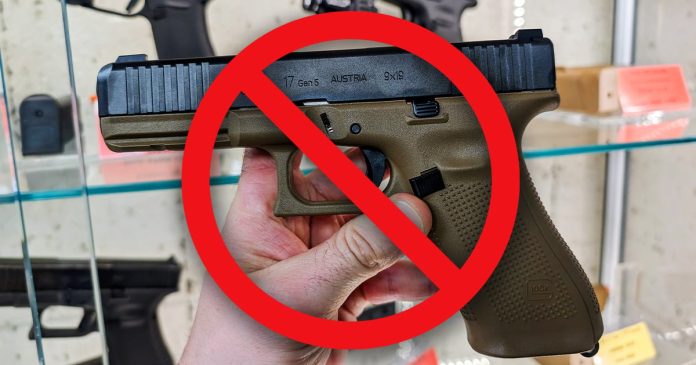
Here is what counts as a convertible pistol under the law: any semiautomatic pistol with a cruciform trigger bar that can be readily converted into a machine gun by hand or with a common household tool through a pistol converter. The law carves out hammer-fired pistols and striker-fired designs with a shielded trigger bar. In plain terms, the target is the striker-fired handgun. The Glock and the many pistols built like it are among the most common defensive handguns in the country.
That is the core problem. The state is not banning a crime. The machine gun conversion devices that lawmakers keep pointing to, the so-called switches, are already illegal under both state and federal law. Possessing or installing one is a federal felony under the National Firearms Act, carrying up to 10 years in prison and up to $250,000 in fines. The criminals using them are already breaking the law. This new statute reaches past those criminals and lands on the law-abiding buyer who simply wants a reliable, widely sold handgun to protect themselves and their family.
NSSF, the firearm industry trade association, says it will challenge the law. Lawrence G. Keane, the group’s senior vice president and general counsel, said the measure punishes the law-abiding instead of the criminals misusing these devices, borrowing a line from Democratic strategist James Carville: “it’s the criminal, stupid.” Keane argued the ban collides with the Supreme Court’s Heller decision and accused Lamont of knowingly trampling the Second Amendment.
More from USA Carry:
He is right on the constitutional question. The Second Amendment is a fundamental civil right, not a privilege the legislature gets to trim down to the gun designs it finds acceptable. Heller is clear that the government cannot ban an entire class of arms that Americans overwhelmingly choose for lawful self-defense. A striker-fired pistol is about as “in common use” as a firearm gets.
Connecticut residents saw this coming. Gun sales surged across the state as buyers rushed to pick up striker-fired pistols before the October cutoff. That is what these bans reliably produce, a run on the very guns the state is trying to push off the shelves, and a lawsuit waiting on the other side.
NSSF has not filed yet, and it is unlikely to be the only group challenging the law. I will be following the litigation closely and will report on the filing and Connecticut’s response as the case moves forward.
Read the full article here