


Key Takeaways
- The U.S. House passed H.R. 1181, the Protecting Privacy in Purchases Act, with a vote of 221 to 201.
- This bill prohibits payment card networks from requiring firearm-specific merchant category codes, blocking the creation of a purchase database.
- Enforcement will involve the Attorney General, who must set up a complaint process and report to Congress annually on investigations.
- H.R. 1181 aims to unify state laws by creating a federal prohibition, replacing the current inconsistent regulations across states.
- The bill now moves to the Senate, where it faces challenges in securing adequate support to overcome a filibuster.
Estimated reading time: 4 minutes
WASHINGTON, D.C. — The U.S. House on Tuesday passed H.R. 1181, the Protecting Privacy in Purchases Act, a bill that would prohibit payment card networks from requiring firearm-specific merchant category codes and block payment processors from assigning them.
The vote was 221 to 201. According to the House Clerk’s official roll call, 215 Republicans, five Democrats, and one Independent voted yes. One Republican, Rep. Brian Fitzpatrick of Pennsylvania, joined 200 Democrats in voting no. The Democrats who crossed over were Reps. Henry Cuellar of Texas, Don Davis of North Carolina, Jared Golden of Maine, Adam Gray of California, and Marie Gluesenkamp Perez of Washington.
The bill is sponsored by Rep. Riley Moore of West Virginia and now heads to the Senate.
Here is what the bill actually does, based on the text reported out of the House Financial Services Committee. It bars payment card networks like Visa and Mastercard from requiring a firearms retailer to use a merchant category code that is used only or primarily for gun stores, or that identifies the retailer as being in the business of selling firearms, ammunition, or firearm parts and accessories. It also bars the banks and processors that handle merchant accounts from assigning those codes.
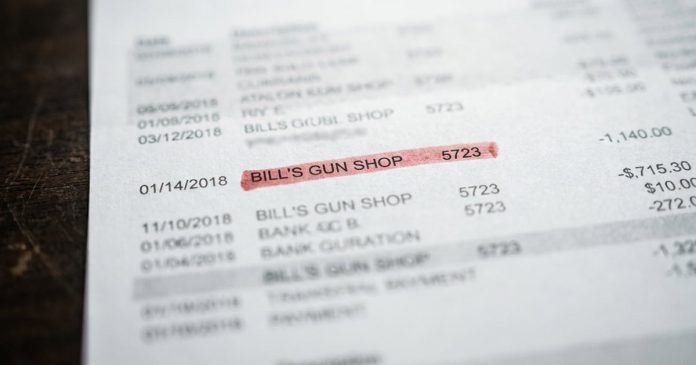
Merchant category codes are the multi-digit classification numbers attached to every business that accepts card payments. A firearm-specific code matters because it would let financial institutions flag and track gun and ammunition purchases as a category, transaction by transaction. That is the raw material for a purchase database that no federal law authorizes the government to build directly. NRA-ILA, which has pushed this bill since its introduction, describes it as blocking a backdoor registry of gun owners assembled through the payment system.
More from USA Carry:
Enforcement runs through the Attorney General, not private lawsuits. The bill directs the AG to set up a complaint process within 90 days of enactment, investigate complaints, and give violators written notice with 30 days to fix the problem. If they don’t, the AG can seek an injunction in federal court. The bill explicitly creates no private right of action, and it requires the AG to report to Congress annually on investigations and outcomes.
The bill also preempts state and local laws regulating the assignment, use, or disclosure of firearm-specific merchant codes. That matters because the states have gone in opposite directions on this issue. California mandated use of a firearms merchant code, while more than a dozen states passed laws prohibiting it. H.R. 1181 would replace that patchwork with a single federal prohibition. The preemption clause carves out compliance with laws related to fraud, dispute processing, and transaction integrity.
Rep. Moore introduced the bill in February 2025 with Reps. Andy Barr of Kentucky and Richard Hudson of North Carolina among the original cosponsors. It picked up more than 100 additional cosponsors before the Financial Services Committee reported it out in February of this year.
The Senate is the harder chamber. A companion effort would need 60 votes to clear a filibuster, and Tuesday’s House margin suggests Democratic support remains thin. I’ll be tracking the bill as it moves to the Senate and will report on any committee action or floor scheduling.
Read the full article here