



I suppose we can begin at the beginning – which is the CPI figures just out from Labor.
The Consumer Price Index for All Urban Consumers (CPI-U) increased 0.2 percent on a seasonally adjusted basis in January, the U.S. Bureau of Labor Statistics reported today. Over the last 12 months, the all items index increased 2.4 percent before seasonal adjustment.
(coughs, politely)
The index for shelter rose 0.2 percent in January and was the largest factor in the all items monthly increase. The food index increased 0.2 percent over the month as did the food at home index, while the food away from home index rose 0.1 percent. These increases were partially offset by the index for energy, which fell 1.5 percent in January.
Core inflation (All items less food and energy 12 mos.) +2.5 percent.
The index for all items less food and energy rose 0.3 percent in January. (Hmm…)
And how about that All Items number which the Fed kept talking about in terms of a 2 percent target? The fact they have been off causes us to wonder how they can spend a billion on a new temple to financial audacity. But that’s me, sound money, and debt-free living showing itself.
Let’s Get Strategic
We will be watching the market closely because the close – ahead of the three day President’s weekend – with all those Navy ships in the Middle East – it’s a time when “weak hands may be shaken out.
BUT going long at the beat-down close this week? Yeah, that’s an Itchy & Scratchy, too.
Sure the CPI matters, but there’s a bigger picture to take in.
First, markets hate uncertainty over long weekends. If CPI reinforces sticky inflation — especially in services, shelter, or insurance components — you’ll likely see positioning reduce risk into the close. Funds don’t like holding oversized exposure when geopolitical and macro headline risk sits idle for 72 hours. That doesn’t mean crash — it means trimming and hedging.
That said, our “state extremes model” is getting into the expected range now – which Peoplenomics subscribers may find useful.
Second, even with CPI, equity multiples don’t implode instantly — but they compress gradually as discount rates stay higher longer. That’s the slow grind scenario, not a discontinuity. That’s the flavor of the 1929-1934 markets. They were called “the Grinder.”
Judging by the (Lindbergh) kidnapping rhyme, now playing, that would make sense. The Grinder II is lurking this spring. Here’s the key to future: true discontinuities usually require one of three triggers:
- Financial plumbing break (liquidity freeze, credit event, major bank or sovereign stress).
- Military escalation between major powers.
- Sudden policy shock (currency controls, capital controls, sanctions expansion, debt ceiling misfire, etc.).
CPI by itself rarely causes discontinuity. It becomes dangerous only if it forces policy into a corner — for example, inflation stays hot while growth rolls over. That stagflation pressure is what strains systems. Between now and April, the more plausible stress build isn’t explosion — it’s convergence:
- Sticky inflation
- Elevated borrowing costs
- Slowing earnings revisions
- Political volatility
- Ongoing global conflict risk
- Commercial real estate and refinancing pressure
That convergence can create fragility. Fragility + catalyst = discontinuity. But fragility alone just produces chop and volatility.
March Looms: Rally, Pretend, then End?
What? Like the Big Bad Compounding Wolf (BBCW) isn’t going to “blow over World?” Seriously?
Friend, April could be fugly. Historically that’s earnings season pressure plus potential fiscal theatrics. If credit spreads widen meaningfully or sovereign yields spike (watch Japan and EU as well), that’s when you begin to see stress migration across borders. But here’s the important distinction:
- We are not on the edge of automatic disaster.
- We are in a late-cycle tightening environment with geopolitical overhang.
- That is unstable, but not inherently explosive without a trigger.
Your bigger macro signals to watch over the next 6–8 weeks: (these are the fire alarms)
- Credit spreads widening sharply
- Liquidity draining (repo stress, funding spikes)
- Sudden dollar surge
- Energy shock
- Policy miscalculation
Absent those, what you get is grind, not cliff.
There. All better now?
Crypto Dipt
Yeah. It has taken over 10-years for this Ponzi to unravel, but that’s what happens in Long Wave economic cycles. Bitcoin was back into the $66,000s at press time.
I have always had a problem with crypto. Because at its core there’s nothing but a “made up number.” But there is this one other thing.
Crypto accounting doesn’t make sense. Here are two headlines I’m blocking out time to reconcile: Coinbase posts $670M Q4 loss as it expands beyond trading Which is a country mile different than Coinbase swings to $842 million loss as crypto market crumbles | The Straits Times. Pick a number, any number…
Too Much? Too Deep? Here’s what MAY come after crypto: the Replay analog to Trading Stamps.
During the Depression, trading stamps exploded not because they were gimmicks, but because they turned scarce cash into delayed purchasing power. Companies like Sperry & Hutchinson (S&H Green Stamps) expanded rapidly in the 1930s by offering consumers a rebate-in-waiting: spend today, collect stamps, redeem later for household goods.
For cash-strained families, stamps functioned as a parallel savings mechanism — a way to accumulate value in small increments without formal banking. For retailers, they preserved customer loyalty in a brutally competitive, deflationary environment. In a grinding economy where margins were thin and confidence thinner, trading stamps were a behavioral innovation — stretching purchasing psychology when liquidity was scarce and trust in institutions was strained.
Much of trading stamp market share was eaten by credit card reward programs. When liquidity tightens and trust thins, parallel value systems always re-emerge.
Trump Won’t be Wagged
Well, that apparently didn’t go too well: The meeting this week between Trump and Israeli leader Netanyahu.
Which we immodestly infer from Trump says Israeli president should be ashamed over Netanyahu pardon, Herzog responds: “Israel operates by the Law” – Middle East Monitor.
Still, while war is NOT likely over this weekend, US sending second aircraft carrier to Middle East amid rising tensions with Iran, report says | The Independent.
The carrier Bush is likely now on station. Which means computer models somewhere are putting the Ford in “that part of the world” around mid-March. And that’s possibly the fire-starter in the wings for markets.
Another Shutdown?
Incompetent government, anyone? DHS shutdown imminent as Senate leaves town without deal
My head hurts when I see stories like Tom Homan says federal agents found thousands of missing children in Minnesota. Here’s a fact check – CBS Minnesota. Because the facts cited don’t match what the feds are using. Different data sets – but are they conclusive “facts?” Depends what day of the week, whose narrative, and clicks, maybe? This is what bothers me about the faddish American preoccupation with “fact-checking.” If you don’t use the same data book, OF COURSE there will be differences. What a pant load runaway “facting” is, huh?
And here’s the latest in the long wave econ Lindbergh replay: Pima County Sheriff’s Department reportedly blocks FBI from accessing Nancy Guthrie evidence – KTAR.com
Around the Ranch: My Junior Forest Fire Badge
There I was – burning out the garden in prep for planting around March 1. Burned out the garden nicely and then went to the shop to use the facilities. It was an urgent “sit down” and so…
By the time I got back to the garden? The previously extinguished fire had a “relight” and was already running about 90-feet west – and now into large brush and tall pines.
That’s when the adrenaline hit and Ure’s family history of firefighting kicked in. This was one of those deals where George and a garden hose (right freaking NOW) was the only answer.

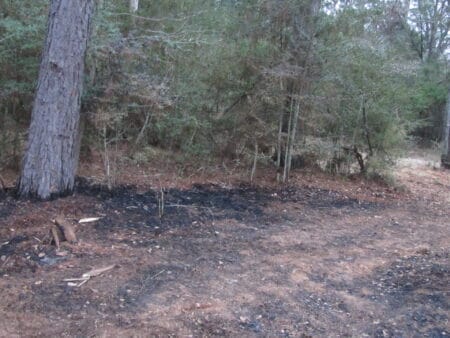
All’s well that ends well. It cleared off an area I was planning to address anyway. And with Big Rain coming in the next few days, this is really a great burning window.
But except for a momentary rush, one man, one hose, and the day is saved…again.
Here’s to the heroes who walk into fires every day: respect.
Write when you feel the spark,
Read the full article here