



OK, let’s get the elephant in the room off the table. Consumer Price figures are just out. And despite the White House pressure, we just don’t see a logical reason to lower rates right now.
WAIT!
Before we do that: Triple A gas price report says year-on-year gas prices were up 28.78 percent. Want to revise your bet on this morning’s number? The envelope, please?
The Consumer Price Index for All Urban Consumers (CPI-U) increased 0.6 percent on a seasonally adjusted basis in April, after rising 0.9 percent in March, the U.S. Bureau of Labor Statistics reported today. Over the last 12 months, the all items index increased 3.8 percent before seasonal adjustment.
The index for energy rose 3.8 percent in April, accounting for over forty percent of the monthly all items increase. The shelter index also increased in April, rising 0.6 percent. The index for food increased 0.5 percent over the month as the index for food at home rose 0.7 percent and the index for food away from home increased 0.2 percent.
The report didn’t highlight energy up 17.0 percent year-on-year.
Of course, the key number in all this is the all-items less food and energy number. 2.8% Year-on-year. Which is so far from the Powell “2 percent talking point” it’s absurd. I mean, if you and I can figure out 2 percent is a hookah number, and we’re not in D.C. – why the BS/disconnect? Don’t think of it as 0.8 percent – think of it as 40% off.
Oh and the answer? (*To “What’s in your wallet?”): Not as much purchasing power as yesterday.
Tracking: the NFIB Small Business Optimism Index rose 0.1 points in April to 95.9, below its 52-year average of 98.0 for the second consecutive month. The Uncertainty Index fell 4 points from March to 88, remaining well above its historical average of 68.
War Surveillance
With the statue of Donald Trump out for a few days getting Chinese (What to Know About Trump-Xi Summit with Trade, Taiwan and Iran on the Agenda) we can turn to the “What’s next?” in the Middle East. From Dim Sum to dimmed prospects.
We’re wondering “What’s in your airplane?” as Trump to Be Joined by Elon Musk and Other CEOs at Xi Summit in China. M&A talks? (Kidding…I hope!)
My consigliere was worried about the rumors that another “pistol Pete General’s meet” was in the offing – which might set a “shot-clock” for Iran. But so far – with some pretty good AI going deep into the research, here’s what’s coming back so far:
What does smell real:
-
- Quiet readiness activity around Hormuz and munitions depletion.
- Internal concern about stockpiles and escalation thresholds.
- Possible posture review involving naval escort operations and CENTCOM coordination.
One thing worth watching:
The earlier Quantico event was called on extremely short notice and initially had almost no stated purpose. So if another one appears, the first signals will likely be:
-
- charter flight chatter,
- unusually high transient officer movement into Quantico/Andrews,
- defense reporter posts about “urgent” scheduling,
- or sudden changes in combatant commander travel.
At the moment, though, I’d say:
No confirmed generals fly-in this week — but elevated command-level activity around Iran/Hormuz is clearly underway.
What we did pick up on was Trump orders aggressive leak probe over Iran war media reports. Yes, we do deploy AI on many “news surveillance” missions. Electrons seems to work more tirelessly than I can, anymore. Been a slow but useful innovation we started chronicling on the Peoplenomics.com subscriber site since April 2015 when we outlined Should You Build a Home Intelligence Platform? And more importantly, should you use it for Trading? We also coined the edge term cobots back in 2017 in Cobots – some thoughts on historical circularity and our mixed intelligence future. This was before I got serious and doing patentable AI research… Rest of the world will be along shortly. (More in the Around the Ranch part in a sec.)
First, gather ’round for the Premier Edition of…
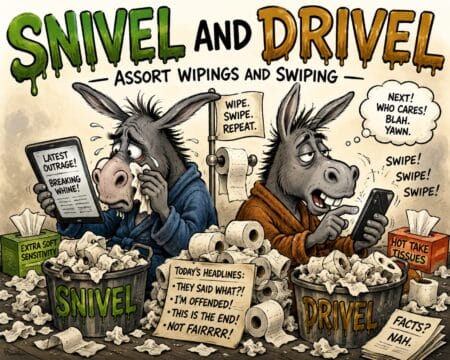
Yes, here’s how Reality is parsing in East Texas today:
Who says crime doesn’t pay? Instructure Strikes Deal for Hackers for Return of Canvas Data – The New York Times.
But it also doesn’t pay forever: Eileen Wang resigns, will plead guilty to acting as Chinese agent | CNN.
Party time in Alabama – question, though is which Party? Supreme Court hands Alabama major boost in redistricting fight – The Washington Post
One of these days Trump will run out of talking-points. Just not today: Trump’s gas tax holiday pitch faces early Capitol Hill headwinds.
And here’s our “You gotta-be-shittin-me” of the day: A nonprofit sues the feds over plans to paint the Lincoln Memorial Reflecting Pool blue.
Passings: Film critic Rex Reed. He was 87. The End.
Now we can move onto more useful stuff…
Around the Ranch: End of the Ant Hill
There may be a huge change underway in the world right now that almost nobody is talking about plainly.
For a very long time, human civilization has patterned itself after ants. Not literally, mind you. Though if you’ve ever been in Washington D.C. at rush hour, or watched corporate middle management scurry around clutching spreadsheets like sacred scrolls, the resemblance becomes harder to ignore.
Ant societies are built on specialization. Worker ants work. Soldier ants soldier. Nurse ants nurse. Each ant develops around a narrow role inside a larger machine. The colony survives because no single ant understands the whole system. The intelligence emerges from coordination and specialization layered together.
Human civilization copied this model and supercharged it. Over centuries we built gigantic silos of expertise. Economists who only speak economics. Doctors who only see medicine. Engineers who only see engineering. Politicians who only see power. Climate people who only see climate. AI people who only see algorithms. Lawyers who can argue the curvature of space-time but cannot rotate a tire or grow a tomato.
And for a while, specialization worked brilliantly. Then it faltered. Then we got to today.
Sure, we built bridges, aircraft, antibiotics, semiconductors, and the modern world. But something strange has happened over the past couple of decades.
The silos have grown so tall that fewer and fewer people can see across them anymore. Every domain became its own priesthood. Every specialty developed its own language, credential structure, gatekeepers, funding channels, and approved reality map.
Which is fine until reality itself stops respecting departmental boundaries.
That’s where the cracks begin. Because the real world does not operate in silos.
The garden touches the kitchen. The kitchen touches health. Health touches economics. Economics touches psychology. Psychology touches politics. Politics touches technology. Technology touches energy. Energy touches climate. Climate touches migration. Migration touches social stability. Social stability touches markets.
Everything touches everything. (Don’t think now, but closed systems are like that.)
The silo-holders hate this realization because it threatens the privilege structure.
Once ordinary schmoes begin walking between domains, the monopoly power of specialists weakens. The modern expert economy depends heavily on controlled access to interpretation. The credential often matters as much as the insight. Only lawyers can read “law” for example. (Bullshit.)
So here we be: increasingly people are beginning to realize that the most useful breakthroughs occur not inside the silos but between them nowadays.
Around here we have started calling this domain walking.
The term sounds fancy, but the process is surprisingly ordinary once you notice it.
You go into the garden and suddenly realize you are not “gardening” anymore. You are designing part of a food system.
Then you walk into the kitchen and discover an entirely different domain but totally connected to the first one. Not merely cooking, but preservation, nutrition, energy management, timing, biology, economics, flavor chemistry, storage systems, and social ritual.
Which is why we’ve jokingly begun calling part of this larger space “fooding.” (Which will become Foodening.com)
Not because we need another buzzword. God knows civilization already has enough consultants weaponizing PowerPoint into acts of psychological violence. But because naming a domain changes how the mind organizes it.
And that turns out to matter a lot now and it will mean even more in times ahead.
The hidden revolution may be that humans are beginning to rediscover cross-domain thinking after centuries of forced specialization.
Artificial intelligence is accelerating this process dramatically.
AIs are weird creatures in one important (collaborative) respect: they are not naturally siloed the way human institutions are. A large language model can move from anthropology to economics to diplomacy to gardening to mythology to software design without requiring six departmental budget approvals and a peer-reviewed permission slip from the Journal of Extremely Narrow Expertise. I’ve been up researching with AI tools since, oh, 2 AM today.
That does not mean AIs are automatically right. They don’t tell me “how to think.” Far from it. But it does mean they can help humans – researchers like me – see patterns stretching across multiple barns simultaneously. It’s the new Mind Amplifiers.
And once you begin seeing the connective tissue, the world starts looking very different.
Take the recent wobbling around the “global warming” narrative. Notice something interesting: the loudest people inside the climate silo often have enormous difficulty discussing economics, energy density, agriculture, grid stability, geopolitical incentives, or the institutional funding structures wrapped around climate “science” itself. The world’s going inter-disciplinary, like it or not.
Meanwhile the anti-climate crowd often refuses to discuss atmospheric chemistry, ecosystem stress, pollution externalities, or long-cycle environmental thresholds. Because? Both sides are trapped in silo warfare. Economics, politics – they all share edges.
Neither side can comfortably walk domains.
Which means the public increasingly senses that nobody is telling the whole truth because almost nobody is structurally capable of seeing the whole picture anymore. Believe me when I tell you: At age 77, I’m old enough to remember a time when there was a unitary Big Picture!
This has become a civilization-scale problem. Everyone has their own spin on the Big Pic.
The industrial era rewarded specialization because machinery demanded repeatability. The emerging era may reward synthesis because complexity demands integration. That is a very different cognitive environment.
The people likely to thrive going forward may not be the narrowest specialists, but rather the best navigators between domains. People who can see how economics touches psychology, how AI touches anthropology, how gardening touches resilience, how diplomacy touches ritual, and how recognition itself may sit underneath much of human behavior.
That last one has become especially interesting around here lately.
I’m already four hours deep into some exploratory domain work on what may become an upcoming Peoplenomics piece tentatively titled The Contact Protocol — or possibly Contact Grammar.
The core idea is that humans may possess ancient recognition systems for approaching other intelligences, whether those intelligences are animals, nations, ecosystems, machine systems, strangers, or perhaps someday things even farther outside the ordinary map.
And once again, the interesting part is not inside any single silo.
Anthropology has pieces. Diplomacy has pieces. Animal behavior has pieces. AI alignment has pieces. Religion has pieces. Economics has pieces.
But very few people are trying to line them up side-by-side to see whether a larger pattern emerges.
That’s the real change underway now. Not merely technological change.
Cognitive change.
Here’s the part the silo-keepers hate: the walls were never real. They were filing cabinets. Department names. Budget lines. Academic turf maps. Useful for organizing work, maybe, but not for understanding reality. Reality does not care what department owns the grant.
The garden talks to the kitchen. The kitchen talks to health. Health talks to money. Money talks to politics. Politics talks to machines. Machines talk back. That’s a domain not a silo.
That is why domain walking is coming. Once people learn to move across the fences, the credential barns lose their monopoly on explanation.
And when silo doors are thrown open?
Things melt UP.
(Write when you get rich, yada, yada…)
Read the full article here