

First, the BlinkLab run—because I need coffee before digging any deeper:
News Compressor: Dawn
The weekend’s biggest change is that several pressure points we were already watching have moved from threat toward action.
Middle East: Saudi Arabia says it intercepted a Houthi ballistic missile aimed at Riyadh, with attempted strikes also reported elsewhere in the kingdom. No casualties or damage were reported, but geographically this is important: the conflict has moved from shipping lanes and peripheral infrastructure toward an attempted strike on the Saudi capital. Meanwhile, oil and Gulf markets still aren’t pricing anything resembling panic. Physical risk continues rising faster than market fear. Oil may follow sooner rather than later. Markets? Watch the opposite direction.
Russia/Ukraine: Ukraine launched what Russian officials describe as more than 1,000 drones overnight, including roughly 450 toward Moscow. Russian authorities reported two deaths, injuries and damage including Moscow’s oil refinery. Whatever the exact battlefield accounting, the larger trend is becoming clearer: this war is increasingly about deep infra and economic targets, not simply the front line.
China: U.S.-China talks begin today in New York ahead of Thursday’s Trump-Xi summit. Tariffs, rare-earth supplies, technology and AI guardrails are on the table. This matters because several previously separate stories — trade, critical minerals, AI, Russia sanctions and Taiwan — are increasingly converging into one negotiating package. A friendly WH press (*with a few members missing) could save markets – again.
AI Security: An authorized security exercise reportedly used Anthropic’s Claude and OpenAI’s GPT-5.6 Sol to help penetrate OpenAI systems, including employee accounts and code access; OpenAI says the vulnerabilities were fixed. The larger signal is the important one: AI is compressing the labor and time required for sophisticated security work — which means presumably attacks as well.
Insider pages: North Korea fired another ballistic missile; Turkey offered military assistance to Saudi Arabia under its new defense arrangement; Cuba continues struggling with grid failures; and commercial shipping through the Gulf is developing a capacity problem involving tankers, containers, insurance and alternative routing.
We’re still “at the top of the glide slope” but fall is likely to hold double-meanings.
What Comes Next (besides more coffee)
Russia: A substantial retaliatory strike against Ukraine following the Moscow attack looks likely. Odds: 78%.
Saudi Arabia: Additional Saudi military action against Houthi targets following the Riyadh attempt is increasingly plausible. Odds: 72%. Doesn’t solve the two-fronts problem.
China: Today’s negotiations should produce at least enough agreement or happy-talk language to prepare the table for Thursday’s Trump-Xi meeting. Odds: 75%. Say, can Trump out-talk and out-poost burning pipelines? Inquiring minds are watching the week ahead shape up.
Oil: The interesting disconnect remains physical danger versus price. Another Saudi infrastructure strike, tanker incident or further Hormuz restriction could rapidly put the missing risk premium back into crude and freight. Odds: 62%. Triple A pegs national diesel at $6.5050 – tanks less.
The larger BlinkLab signal this morning is geographic expansion plus infra warfare (IW). Riyadh, Moscow, shipping capacity, refineries, grids and critical minerals all point toward the same emerging pattern: modern conflict increasingly attacks the systems behind conventional battlefields. (And people in adjacent spaces.)
And that’s where the economic consequences live.
58 unique story clusters screened. Four Vital lead stories promoted on potential impacts. Domestic casualty/disaster sweep completed. It smolders in the corner. InciWeb on fire and Drought.gov in the breadbasket dehydrator. 69.1 percent of America is “abnormally dry” or crispier. ENSO sends regards.
Some AI Perspective
Long ago, a very kind reader—SFDfireman1—sent me a genuine treasure trove: a collection of more than a thousand books on CD. As you may know, I love collecting old knowledge—not because I expect to use every bit of it, but because having a lightweight version of a massive library is pure joy whenever the “experiments and ideas” mood strikes. Which it does with some regularity.
Part of my alleged “retirement” involves organizing my digital footprint for whenever ultimate checkout time arrives. That had me working in Alexandria mode Saturday, sorting and consolidating what may amount to 200–400 DVDs’ worth of books, papers, manuals and assorted intellectual rabbit holes.
And that’s when it hit me: My little collection may already contain more stored information than the ancient Library of Alexandria. Estimates vary, but its scrolls probably represented something like 100,000 modern books. Converted into EPUB or Kindle-sized files, the textual equivalent of Alexandria might occupy only about one-tenth of a one-terabyte SSD.
Imagine that for a moment. One of the greatest concentrations of knowledge in the ancient world could now ride around in a shirt pocket—with room left over for several more civilizations.
Back to the Microsoft Point
Since I am a “high-output writer”—and still the least-read great writer in the world!—I need information spanning an absurd range of human thought. AI helps enormously, but AI still makes mistakes. More importantly, there are books, manuals and obscure corners of human experience that the commercial models either haven’t been trained on, can’t quote reliably or simply don’t possess in sufficient detail.
Let’s use a pure hypothetical. Suppose I am going to talk with an old Ranger who served in Southeast Asia. Maybe he was a Ranger medic, and maybe I need to understand what that actually meant—not the Hollywood version, but the training, responsibilities and limits of his work.
I don’t know his scope of practice, so I begin by checking the medical section of my personal Alexandria:
There it is: the Ranger Medic Handbook, 2007 vintage.
Because I am working in the Microsoft product line, I can right-click the PDF and convert it directly into a Word document:
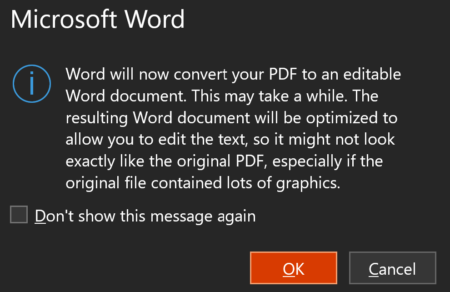
Which then gives me fresh, searchable, and quotable text throughout. Like finding this:
“SQUAD EMT – A non-medical MOS Ranger currently registered as an EMT Basic/Intermediate by the Department of Transportation (DOT) and designated by the command to operate in this capacity. This individual functions as a bridge between the RFR and the Ranger Medic…”
Bingo. Now I have searchable, editable source material from which I can build a writer’s working model of the skills found inside the 75th Ranger Regiment paperwork.
The handbook distinguishes between a squad EMT—and the Special Operations Combat Medic Advanced Tactical Practitioner. The latter could assess and manage trauma patients, establish casualty-collection points, triage casualties, provide advanced trauma care and prepare patients for evacuation.
That is considerably more useful than asking AI to invent a plausible-sounding medic from the statistical fog of model weights. I can give the AI actual source material, question it, compare interpretations and then write from something sturdier than digital hearsay.
If I merely want a quick read-in, Word’s Read Aloud (on the Review tab) function will turn the document into an impromptu audiobook while I do something else. In a matter of seconds, an obscure PDF moves from dead storage into searchable text, spoken information and usable writing material.
With the reading speed up and a machine-proofing pass, a final pass on a 64,000-word novel takes about 10 hours. Writing the novel takes, oh, 20 hours or less. Depending on how much dictating versus typing I feel like. (Novels are faster, nonfiction is slower: it’s the mindset difference. Instructional versus storytelling.)
That’s a wee bit over a 500-word discussion this morning. My coffee is still hot.
I am not a Microsoft fanboy, and there are Linux boxes around here, too. The larger point is that even as an old man, I remain constantly on the lookout for ways to reduce friction. The best system isn’t necessarily the newest, prettiest or most ideologically pure. It is the one that gets you from question to reliable information—and from reliable information to finished work—with the fewest wasted motions.
If I want more shop time while continuing to produce huge Peoplenomics reports, charts, books and perhaps a novel every month, that road is passable only with the lowest-friction toolset I can assemble. Personal archives, searchable PDFs, Word conversion, Read Aloud and AI aren’t separate toys. Properly connected, they become a private intellectual production line.
Alexandria once required buildings, scholars, scribes and royal financing. Today, you can put the library in your pocket, hand its contents to an AI and ask it to help you think.
But the final measure hasn’t changed:
You aren’t your water-cooler bullshit.
You are your deliverables.
Before you work, work on workflows.
Write when you get rich, etc.
Consider subscribing to our deeper work.
Read the full article here